
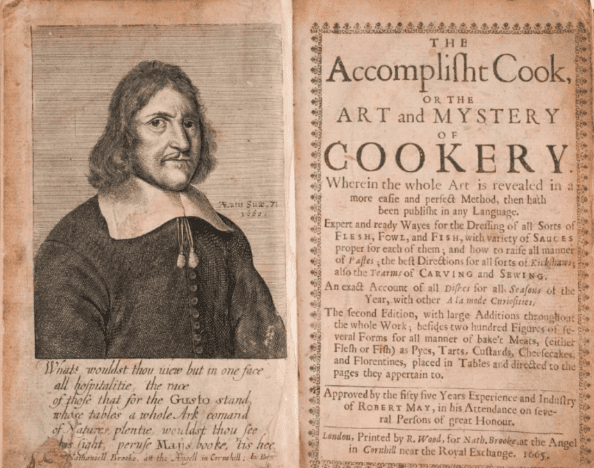
1660- Robert May “Accomplisht Cook”
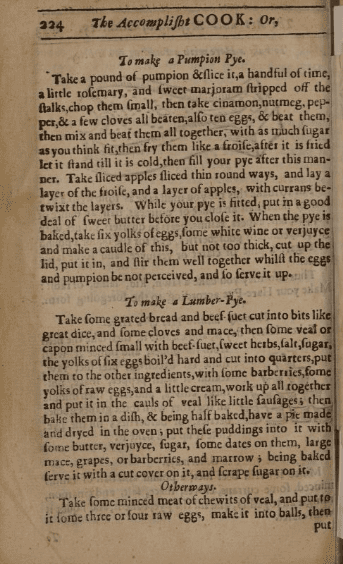
“To make a Pumpion Pie.”
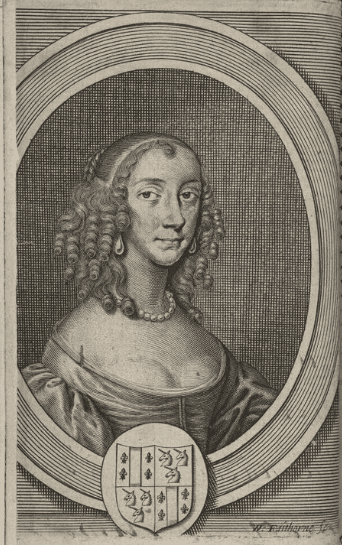
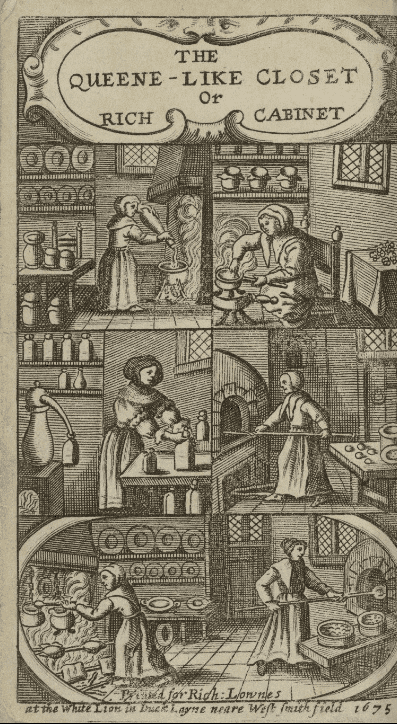
1670- Hannah Wolley “ The Queen-Like Closet or Rich Cabinet”
“Your Kind and Good Acceptance of my Endeavours in Work for You, and that Esteem You have for what else I can do, make me bold to present this Book to You; which by that time You have perused, I doubt not but You will deem it worthy of the Title it bears; and indeed it was never opened before: If it may yield You any Delight or Benefit, I shall be glad; for as You have a true Love and Esteem for me, so I have a very great Love and Honourable Esteem for You; and shall always be
_Your most Observant servant_
HANNAH WOLLEY.”
“92. To make a Pompion-Pie.
Having your Paste ready in your Pan, put in your Pompion pared and cut in thin slices, then fill up your Pie with sharp Apples, and a little Pepper, and a little Salt, then close it, and bake it, then butter it, and serve it in hot to the Table.
- To fry Pompion.
Cut it in thin slices when it is pared, and steep it in Sack a while, then dip it in Eggs, and fry it in Butter, and put some Sack and Butter for Sauce, so serve it in with salt about the Dish brims.
- To make a Pumpion Pie.
Take a Pumpion, pare it, and cut it in thin slices, dip it in beaten Eggs and Herbs shred small, and fry it till it be enough, then lay it into a Pie with Butter, Raisins, Currans, Sugar and Sack, and in the bottom some sharp Apples; when it is baked, butter it and serve it in.”
Modern Adaptation of 17th century Recipes:
2 Sharp Apples (Granny Smith, but any apple will do)
3 Eggs
2 Handfuls of Herbs Freshly Minced (Rosemary, Thyme, Parsley, Sage, and/or Sweet Marjoram)
6 Tablespoons (85g) Salted Butter
1/3 cup (50g) Raisins
1/3 cup (50g) Currants
½ cup (100g) Sugar
¼ cup (60 ml) Sack or Sherry
Pie Crust (pre-made from store is fine- get shortcrust, not puff)
Preheat Oven to 220 C
You can blind-bake the pie crust if you would like, but it is not necessary.
Step 1: Prepare Pumpkin & Apples
Slice off top, peel skin off pumpkin, carefully slice pumpkin in half. Carve out seeds and strings. Slice halves in half again. Then cut into thin slices, like Julienne.
Peel apples and core them. Slice in halves and then thinly slice.
Step 2: Fry Pumpkin
Set large skillet over medium heat. Melt two tablespoons of butter (you can also use oil, lard, or any other fat that you can fry in).
While that melts, beat eggs in a bowl and mix in herbs.
Dip pumpkin slices into the egg & herb mixture. Do not overcoat with egg! This will lead to scrambled eggs in your pie! Place them into the hot skillet. Fry until fairly soft (about 10 minutes).
Step 3: Make Pie
Put slices into a large bowl. Add two tablespoons of butter (reserve the rest for the end). Add the raisins, currants, sugar, and sack (or sherry). Mix gently.
Line the bottom of your pie crust with the apple slices. Layer the pumpkin filling on top and smooth.
Bake in oven at 220 C for 20 minutes.
Reduce temperature to 190 C and continue baking for 40-50 minutes.
Remove from the oven and place the last 2 tablespoons of butter sliced across the top. Enjoy warm!
Stay tuned for next week when we explore 18th century pumpkin pie!
18th-Century Pumpkin Pie Recipes

ameila simmons

amelia simmons 1796 front cover

Amelia Simmons 1796 pumpkin pie

Gov William Burnet of NY with NA leaders 1721
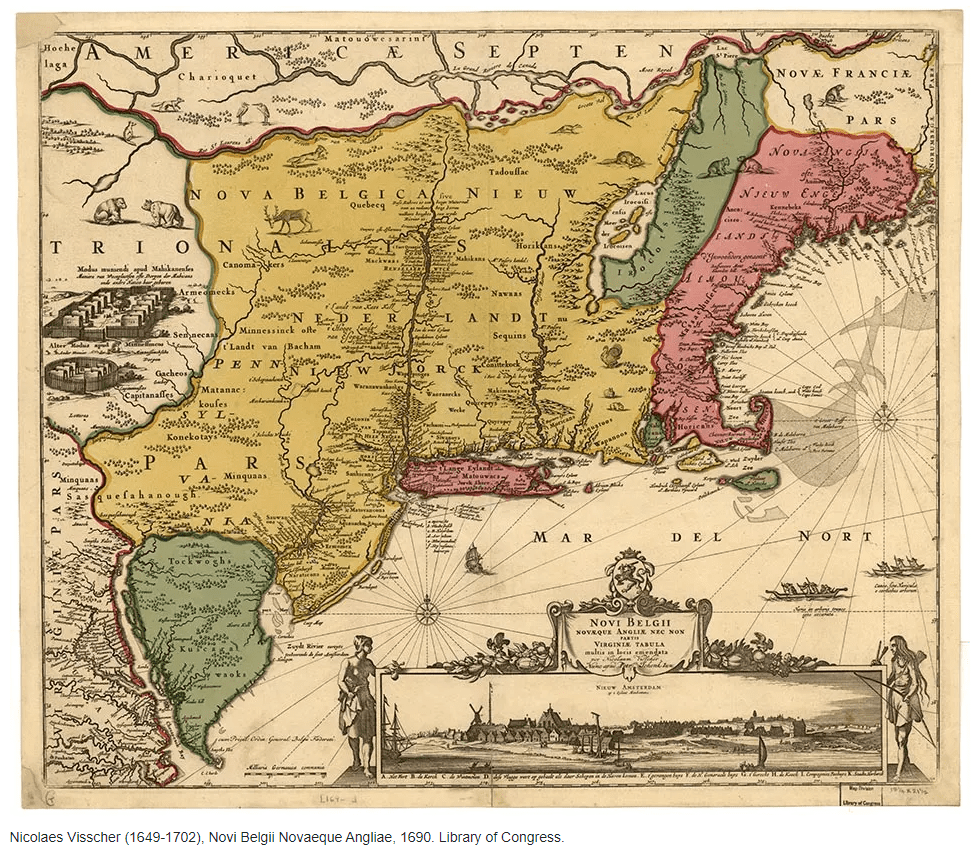
Hudson Indian map

treaty of penn with the indians 1771
1796 Amelia Simmons- “American Cookery”
“Pompkin.
No. 1. One quart stewed and strained, 3 pints cream, 9 beaten eggs, sugar, mace, nutmeg, and ginger, laid into paste No. 7 or 3, and with a dough spur, cross, and chequer it, and bake in dishes three quarters of an hour.
No. 2 One quart of milk, 1 pint of pumpkin, 4 eggs, molasses, allspice, and ginger in a crust, bake 1 hr.”
For more information on pumpkins in Colonial America check out Colonial Williamsburg’s research blog:
https://research.colonialwilliamsburg.org/Foundation/journal/Autumn09/pumpkins.cfm
Modern Savory Pumpkin Recipe from the Smithsonian Voices Native American Project:
“Savory pumpkin
1 small pumpkin or large butternut squash, peeled cut and diced in 1-inch cubes, then rinsed
6 green onion stalks about 2 inches long, cleaned and without roots, chopped long ways into ruffles
1/2 cup red bell peppers, chopped and diced
1/2 cup red onion, chopped and diced
4 tablespoons butter
2 teaspoons olive oil
2 teaspoons salt
Freshly ground pepper, about 4 turns
1 teaspoon cinnamon
3 tablespoons brown sugar, optional (you may also use honey)
2 garlic cloves, minced
1/3 cup water
Prepare the pumpkin and other vegetables.
In a skillet over medium high heat, melt the oil and butter. Add diced onions, ruffly chopped green onions, red bell peppers, and garlic and sauté, stirring constantly. Add the rinsed cubed pumpkin pieces and sauté, flipping the pumpkin over as you add salt, pepper, and cinnamon.
Add water, bring to a simmer, and reduce heat. When the pumpkin is cooked al dente, add brown sugar and continue to simmer until a light syrup forms and pumpkin softens. Let cool.
Modern Adaptation of Pumpkin Pie:
1 Sugar or Pie Pumpkin (or 1-2 cans of pumpkin puree)
*Note- if you use real pumpkin you will need to prepare the pumpkin by removing top, skin, seeds, strings and then put the chunks in the oven on a tray or fry them to soften. Then mix in blender or food processor to make a puree. You may want to put the puree through a strainer.
1 cup (240 mL) evaporated milk.
1 can (4oz or 414 mL) condensed milk.
Nutmeg/Mace, Allspice, Clove, Ginger, Cinnamon (Any combination to taste. Usually about ½ – 1 teaspoon each.
2 large eggs
½ teaspoon salt
Sugar, honey, molasses to taste if desired (if you use molasses go easy!). I find it unnecessary to add any additional sugar as the condensed milk is sweetened. You can forgo the condensed milk and use sugar, honey, or molasses instead.
Pie Crust (pre-made from store is fine- get short crust, not puff)
Preheat oven to 160 C
Step 1: Blind Bake Pie Crust
Place crust in dish and blind bake for 10 – 15 minutes at 160 C. Do not overcook!
After removing pie crust from oven, increase temperature to 220 C.
Step 2: Prepare Ingredients
Mix all the ingredients in a large bowl. Once thoroughly mixed, pour into the blind baked pie crust. foil the rim of the pie so the crust does not burn.
Step 3: Cook
Place in centre of oven on 220 C for 15 minutes. Then immediately reduce heat to 160 C. Bake another 30-40 minutes. It is done when a toothpick comes out dry.
Serve warm with custard or whipped cream (Bailey’s is good!)
Let us know what you think! Happy Pumpkining!
For a great little archive of historical Scottish recipes, visit the National Library of Scotland:
https://digital.nls.uk/recipes/themes/index.html
For a general summary of Indigenous American Peoples and more information on racism and cultural appropriation:
https://www.britannica.com/topic/Native-American/Native-American-history
https://www.nationalarchives.gov.uk/education/resources/native-north-americans/
https://www.smithsonianmag.com/history/the-indigenous-americans-who-visited-europe-180981496/
https://www.jstor.org/stable/1185964?seq=4
Academic References for the Facebook post:
Conway, Stephen. “From Fellow-Nationals to Foreigners: British Perceptions of the Americans, circa 1739-1783.” The William and Mary Quarterly, vol. 59, no. 1, 2002, pp. 65–100. JSTOR, https://doi.org/10.2307/3491638
Cormier, Paul Nicolas. “British Colonialism and Indigenous Peoples: The Law of Resistance–Response–Change.” Peace Research, vol. 49, no. 2, 2017, pp. 39–60. JSTOR, http://www.jstor.org/stable/44779906
Flack, B.M. Conciliation—Compulsion—Conversion: British Attitudes towards Indigenous Peoples, 1763–1814. 2004. Rodopi: New York.
Mancall, Peter C., ‘Native Americans and Europeans in English America, 1500–1700’, in Nicholas Canny, and Wm Roger Louis (eds), The Oxford History of the British Empire: Volume I: The Origins of Empire: British Overseas Enterprise to the Close of the Seventeenth Century, The Oxford History of the British Empire (Oxford, 1998; online edn, Oxford Academic, 3 Oct. 2011), https://doi.org/10.1093/acprof:oso/9780198205623.003.0015
BONUS RECIEPE IDEA!
Below is advice from an 18th century magazine for making pumpkin bread!
“Slice a pompion, and boil it in fair water, till the water grows clammy, or somewhat thick; then strain it through a fine cloth, or sieve, and with this make your Bread, well kneading the dough; and it will not only increase the quantity of it, but make it keep moist and sweet a month longer than Bread made with fair water only.”
The Family Magazine, 1741
Catherine is a member of our history team and provides the living history interpretations in the kitchen and laundry via the wash tub time machine.

Election Time!
Sir Hugh Paterson, 3rd Baronet & The Elections of 1708-15 By Andrew Colquhoun The loyalties of Sir Hugh Paterson, 3rd Baronet and laird of Bannockburn House, were to the exiled House of Stuart. Politics in early eighteenth-century Scotland was rent by sharp...

March Brings Breezes Loud and Shrill, Stirs the Dancing Daffodil
March Brings Breezes Loud and Shrill, Stirs the Dancing Daffodil The first daffodils are always such a welcome sight, a flower of renewal and rebirth. They are impossible to ignore as the neon-yellow-ness of the bobbing flower pierces through any shrubbery, dreary...

Breaking News: Major National Funding Secures Emergency Works at Bannockburn House
The Rescue Begins Major National Funding Secures Emergency Works at Bannockburn House Good news really does come in threes! Bannockburn House Trust is delighted to announce that three major heritage funders have awarded a combined £325,432 to support urgent...
Winter’s End & Spring’s Beginning
Winter’s End and Spring’s Beginning This seems to have been a long, dreary winter. For us here, in central Scotland, our photos record some snow and the there were some sunny, frosty days but it is hard to recall them as there has been such a long stretch of...
New Find in the Bed Linked to Bonnie Prince Charlie at Bannockburn House Deepens the Assassination Attempt Mystery
SPECIAL ANNOUNCEMENT Bannockburn, Stirling - [4 February 2026] Researchers at Bannockburn House have identified new evidence in the suspected assassination attempt on Bonnie Prince Charlie during his stay in January 1746. A lead ball consistent with 18th century shot,...
Possets, Princes, & A Proper Bannockburn House Night In…
Possets, Princes, & A Proper Bannockburn House Night In... Winter has always had a way of creeping into the bones. Long before central heating, antibiotics, or the luxury of staying home with a hot water bottle, people in the 17th and 18th centuries still...
Welcome to National Tree Week. – Ancient Lime Trees
Welcome to National Tree Week. - Ancient Lime Trees - by Margaret Pollock Next time you visit us, see if you can spot our two majestic rows of veteran Lime trees (Tilia x europaea). They create a wind break and originally marked out some of the boundaries of...

Welcome to National Tree Week. – News From Bannockburn House Gardens
Welcome to National Tree Week. The Bannockburn House Trust Garden Blog - by Margaret Pollock Trees are special. They store carbon, replenish oxygen and conserve our soil; they give us food and shade, building materials for our homes and irreplaceable habitats for...

Riches from the Garden – News From Bannockburn House Gardens
Riches from the Garden The Bannockburn House Trust Garden Blog - by Margaret Pollock Summer 2025 is proving to be a bumper year for all our crops. In June and July we had mountains of Blackcurrants. Our harvested onions are huge and now we are picking boxes of...

Summertime and the Livin’ is Easy – News From Bannockburn House Gardens
Summertime and the Livin’ is Easy The Bannockburn House Trust Garden Blog - by Margaret Pollock After such a warm, sunny spring this year it has come as no surprise to us that we have a bumper blackcurrant crop this year. Our bushes were planted in the spring of 2020,...