
The Rescue Begins
Major National Funding Secures Emergency Works at Bannockburn House
Good news really does come in threes!
Bannockburn House Trust is delighted to announce that three major heritage funders have awarded a combined £325,432 to support urgent emergency works at Bannockburn House. It is critical first step in what is expected to become one of the largest community-led conservation and restoration programmes ever undertaken in Scotland.
This support from The National Lottery Heritage Fund, The National Heritage Memorial Fund, and Historic Environment Scotland will allow work to begin on stabilising some of the most vulnerable parts of the building, protecting its rare historic fabric and helping secure its future.
After decades of water ingress, failing masonry and structural movement, the house had reached a point where urgent intervention was essential. Without action, Bannockburn House risked losing irreplaceable features, including its original roof structure and the extraordinary plaster ceiling of the Blue Room, one of the rarest survivals of its kind in Britain.
The emergency works now under way will focus on stabilising vulnerable masonry and timber, improving weatherproofing, and protecting nationally significant interiors. Alongside this, the project continues to reveal remarkable new evidence about the history of the house, from traces of historic painted decoration to the recently announced evidence of a failed assassination attempt on Bonnie Prince Charlie.

Photo Copyright Historic Environment Scotland
The Work Few People Ever See
Some of the most urgent work at Bannockburn House is taking place high above the ground.
There, specialist heritage contractors are carrying out repairs in exposed and demanding conditions, where every tool, every bucket, and every piece of material must be managed with immense care. It is physically gruelling work, but it is also skilled conservation in its purest form: slow, deliberate, and respectful of the fragile historic building beneath it.
Among the crafts involved in this kind of work is the tradition of the steeplejack.
Today, many people may never have heard the word. Yet for generations, steeplejacks have been the men who worked where few others could: on church towers, chimneys, roofs, spires and other tall structures. A modern museum summary describes them as skilled tradespeople who assess, maintain and construct tall buildings, structures and towers, and notes that the name comes from their historic association with ecclesiastical buildings.
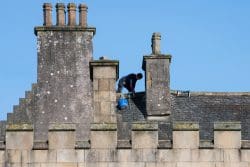
Photo Copyright Historic Environment Scotland
Older Than the Name
The trade itself is older than the word.
In medieval and early modern Scotland, there was probably no separate profession formally called “steeplejack.” Instead, high-level repairs were carried out by masons, wrights and slaters — the established building trades responsible for church towers, roofs, steeples and upper masonry. Scottish craft incorporations for masons, wrights and slaters are documented from the medieval and early modern periods, showing that these were the trades historically responsible for such work.
That matters because it helps explain what steeplejacking really is. It did not appear from nowhere as a pure climbing profession. It grew out of the older building crafts, especially the trades that already had to work at height on churches, towers, rooflines and chimneys.
So while medieval Scotland certainly had people doing this sort of work, they would more likely have been known as masons, wrights, or slaters, rather than steeplejacks.
When the Word Appears
The name itself seems to be relatively modern. Sources differ slightly on its earliest printed appearance: the Oxford English Dictionary dates the earliest known use of the noun “steeplejack” to the 1880s, while other etymological sources trace it to the mid-19th century, around 1847. Either way, the term belongs to the industrial age rather than the medieval one.
That makes sense. By the 19th century, Britain’s skyline was changing. There were more factory chimneys, larger civic buildings, more churches, more mills, and more structures that needed repair at dangerous heights. As maintenance work on tall buildings became more frequent and more specialised, the role of the steeplejack emerged more clearly as a distinct trade.
How the Trade Changed
Over time, the work evolved.
In earlier centuries, high-level repairs depended heavily on scaffolds, ladders, ropes, and the practical ingenuity of craftsmen trained first in masonry, carpentry or roofing. In the 19th and early 20th centuries, steeplejacks became famous for working on towers and chimneys with extraordinary confidence and economy, often avoiding the need for full scaffolding. They developed a reputation not only for nerve, but for speed, balance, and deep practical knowledge of how buildings behaved at height. Contemporary images and accounts from the 20th century show steeplejacks as the essential “workers-on-high” of industrial Britain.
In the modern world, some aspects of that work overlap with rope access, but the two are not quite the same.
A rope access technician may be highly skilled in access systems alone. A heritage steeplejack, by contrast, often brings together access expertise and practical knowledge of traditional building trades. On historic buildings, that may include leadwork, slating, lime mortar repairs, stonemasonry, and sometimes joinery. In that sense, the best steeplejacks still reflect the older roots of the trade: craftspeople first, height-workers second.
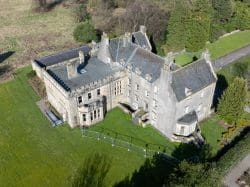
Photo Copyright Historic Environment, Scotland
Why It Matters Here
That is exactly why this kind of specialist skill matters at Bannockburn House.
Historic buildings cannot simply be treated like modern structures. Repairs must be careful, compatible, and informed by an understanding of traditional materials and methods. Working high on a fragile roof or upper wall is not only a question of access. It is a question of judgement, experience, and craft.
From the ground, these workers can appear almost silhouetted against the sky — small figures moving carefully across the roofline. But what they are doing is enormously significant. Their work helps protect not just stone, slate, timber and plaster, but the survival of a nationally important building and the stories held within it.
Saving the Blue Room and Beyond
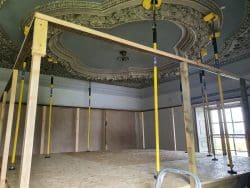
One of the most significant features being protected through this emergency programme is the celebrated Blue Room ceiling, thought to be the work of the same craftsmen responsible for similar ceilings at Holyrood Palace in the late 17th century. Support from the National Heritage Memorial Fund will help conserve this exceptional survival, while the wider programme supported by The National Lottery Heritage Fund and Historic Environment Scotland will stabilise the house and provide a foundation for long-term recovery.
This is only the beginning!
Bannockburn House Trust’s long-term vision is to conserve the house as a nationally significant historic site while developing it as a centre for research, heritage skills and public engagement. The current emergency works are the vital first phase of that journey.
Bannockburn House Trust would like to extend its sincere thanks to our current funders for their invaluable support. We are especially grateful to the National Lottery Heritage Fund, Historic Environment Scotland, and the William Grant Foundation, whose generosity is helping us conserve, restore, and share Bannockburn House for the benefit of the community and future generations.

Using money raised by National Lottery players, The National Lottery Heritage Fund supports projects that connect people and communities with the UK’s heritage. The Emergency Project 1 works at Bannockburn House are made possible with The National Lottery Heritage Fund. Thanks to National Lottery players, we have been able to fund saving the northwest gable wall from collapse, making the house watertight, and helping to ensure the house can remain open to the public safely.

Thanks to the support of The National Heritage Memorial Fund, we are carrying out emergency works to save one of Britain’s rarest 17th century plasterwork ceilings. The funding includes allotments for world renowned specialist plasterwork experts and for conservation engineering and architecture support to design the stabilisation.

Thanks to the support of Historic Environment Scotland, we are carrying out vital emergency works to safeguard Bannockburn House. This includes a specialist timber survey and steeplejack works to assess the condition of the roof and help secure the building against further water ingress.

Thanks to the support of the William Grant Foundation, Bannockburn House Trust has been able to support vital staff capacity during an important period of development. This funding is helping us maintain momentum across our conservation, restoration, and public engagement work.