
SPECIAL ANNOUNCEMENT
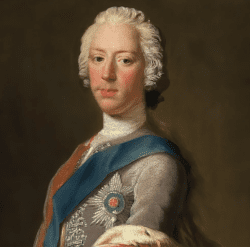
Prince Charles Edward Stuart [1720-1788] by Allan Ramsay [1713-1784] Date: 1745, Accession number: PG 3762. Scottish National Portrait Gallery.
Researchers at Bannockburn House have identified new evidence in the suspected assassination attempt on Bonnie Prince Charlie during his stay in January 1746. A lead ball consistent with 18th century shot, believed to be from a second musket or pistol fired into the room, was discovered within a section of the bed traditionally associated with Prince Charles Edward Stuart. Adding evidence of a second shooter during the assassination attempt, the discovery deepens one of the house’s most dramatic and intriguing Jacobite-era mysteries during a pivotal time in Scotland’s history.
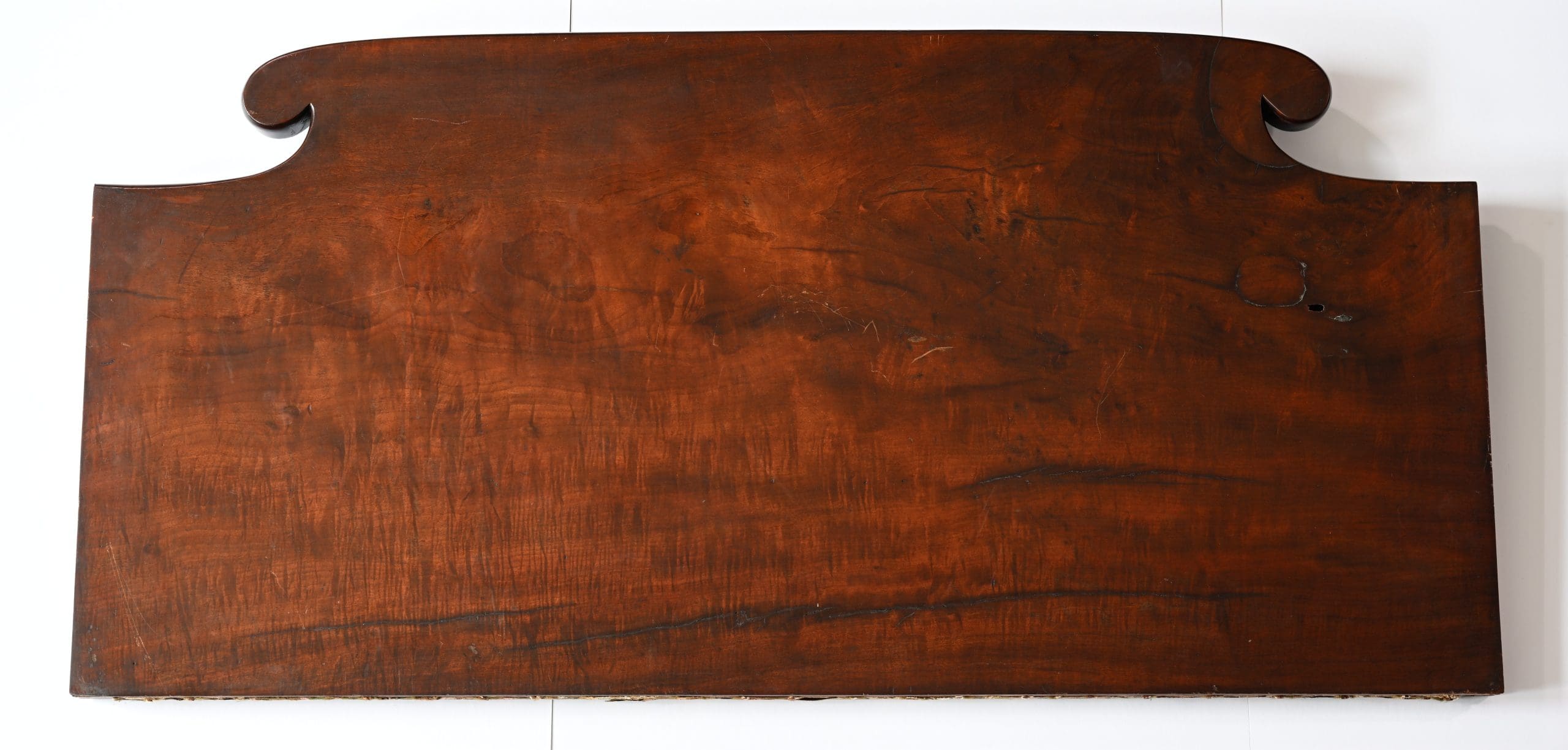
Back of the bed in Bannockburn House used by Bonnie Prince Charlie. Damage from the shot in the bed can be seen on far right side.
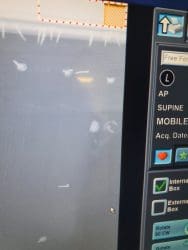
X-Ray of 13.5mm lead ball, likely from an 18th century pistol lodged in bed used by Bonnie Prince Charlie in 1746.
The discovery follows the identification of a musket ball impact in the room’s wall panelling in 2024. During subsequent conservation assessment of a historic bed associated with the room, several unusual features were found within the footboard. Dr. Bradley, the Trust’s conservation and research trustee, became suspicious after finding thick hand cut veneers, historic repairs, and multiple layers of upholstered fabric from different periods on part of the bed. The finds raised questions about the age of the bed and damage which prompted closer investigation.
Using miniature cameras, a projectile was discovered stuck inside a section of the bed. Further investigations to confirm suspicions were undertaken by experts from Robert Gordon University. A deformed projectile measuring approximately 13.5mm was identified on X-ray inside the bed section. Preliminary material analysis by the forensics experts at RGU indicates the presence of lead consistent with an 18th century pistol or musket ball. Traces of gold were also present. Further specialist analysis is planned to confirm the exact type of weapon that fired the ball.
The X-ray and digital documentation imaging work was done in partnership with Bannockburn House Trust by Johns Hopkins University graduate student Katharine Rubinetti, under the supervision of Associate Professor Douglas Pritchard of Robert Gordon University. The work was part of a wider digital curation internship project aimed at creating a publicly available research record of Bannockburn House’s material evidence made possible by a scholarship awarded to Mrs. Rubinetti by the St. Andrew’s Society of Washington DC.
The project stemmed from a three-dimensional technology and documentation field course in the Johns Hopkins MA in Cultural Heritage Management degree program led by Douglas Pritchard. Students from Johns Hopkins University visited Bannockburn House during the spring 2025 semester.
The identification of a second projectile suggest multiple shots were fired. The find has renewed and broadened the historical and archaeological investigation at Bannockburn House. While the first impact on the wall suggested the possibility of a single shooting incident, the presence of a second in a different part of the room raises questions about the event. Researchers are now considering how many attackers may have been involved, how the prince escaped, and whether there is truth to stories of a secret tunnel.
Dr. Bradley notes that the oral tradition in Bannockburn relating to Bonnie Prince Charlie’s stay at the house is long-established, with references to the site attracting visitors as early as the first part of the 19th century. Written accounts from later in the 19th century also allude to a shooting incident associated with the Prince’s presence at Bannockburn House, suggesting a long-held narrative that has persisted for generations.
“What’s genuinely exciting is seeing fragments of that tradition begin to align with physical and archival evidence,” said Dr Bradley. “This has become a careful piece of historical detective work. Every new detail sends us back to the archives, back to the objects, and back to the building itself. We’re testing stories that have been told locally for centuries and finding that some of them may be rooted in very real events. The more we look, the clearer it becomes that there is still a great deal to uncover about the Jacobite Siege of Stirling.”
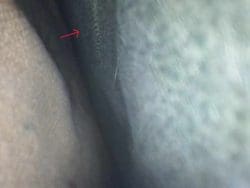
An inspection camera was inserted in between the last two fabric layers of upholstery and revealed a sewn up hole in the oldest layer of fabric associated with damage on the back of the bed.
Remarking on the import role technology played in the discovery, Professor Douglas Pritchard said, “This research improves our understanding of the Jacobite Rising and the dangers faced by Bonnie Prince Charlie. These technologies allow for the digital preservation of fragile objects and sites, creating records that support further research and public sharing. By capturing these assets accurately and in 3D, we are both expanding our knowledge and guaranteeing their preservation for future study.”
Professor Murray Pittock, Vice Pro Chair of the University of Glasgow, who confirmed the first discovery, will continue to provide historical context as analysis progresses. Earlier assessment of the first impact indicated characteristics consistent with a mid-18th century British Land Pattern musket, a weapon issued to government troops during the period.
Researchers emphasise that interpretation remains ongoing. The emerging evidence does not yet conclusively define the nature of the incident, but it does expand the evidence base and has prompted an investigation into how Prince Charles Edward Stuart left the house and how quickly events unfolded. As part of this work, the Trust is also examining long-standing references to a possible escape route or tunnel, with archaeological investigation planned as research continues.
Malcolm McEwan, Chair of the Board of Trustees at Bannockburn House said, “This project shows what can happen when community-led heritage work is supported by academic and professional expertise. We’re deeply grateful to our university partners and Historic Environment Scotland for their involvement. It’s at this intersection, between local knowledge, skilled practitioners, and research, that discoveries like this are made, and it’s the model the Trust is building its future around.”
Further conservation work, specialist analysis, and archaeological investigations are planned as part of Bannockburn House Trust’s continuing research programme with the first dig for the secret tunnel scheduled for the end of this month by archaeologist, Dr. Murray Cook. The section of the bed containing the lead ball is in fragile condition and will be on display only to the public at the Trust’s event January 31st – February 1st to mark the 280th anniversary of Bonnie Prince Charlie’s stay at Bannockburn House.
Support the conservation work
The section of the historic bed containing the projectile is extremely fragile, and specialist conservation is now underway to stabilise, study, and safely display it for the future. Alongside this, vital conservation work continues across Bannockburn House to protect the building and its remarkable Jacobite-era interiors.
If you would like to help support the conservation of the house and this newly identified object, you can find out more and contribute to the work here:
Visit our Crowdfunder here
Every contribution helps ensure this evidence and the story it tells can be preserved, researched, and shared.
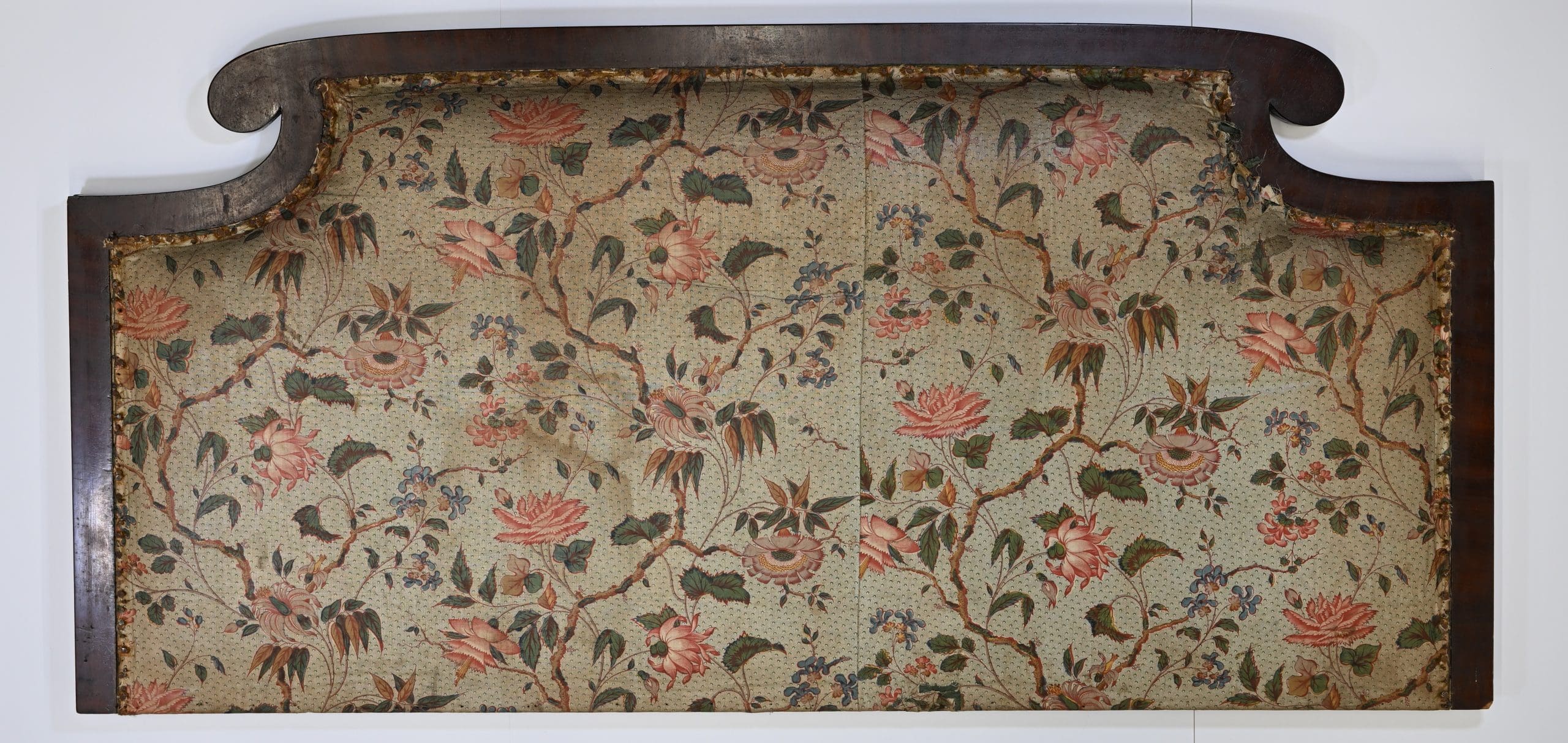
Front side of the headboard showing the second oldest layer of fabric, an 18th century cotton chintz.