
Peach Tree Greenhouse
Week in, week out, the garden team can be found, working on the various areas of the surrounding garden. Often, we are digging or weeding, cutting back overgrown shrubs or decaying trees and sometimes we tackle a new section of the neglected landscape. Of course, each time we reclaim an overgrown area, we increase the amount of land needing ongoing maintenance – a bit like painting an ever-lengthening Forth Bridge!
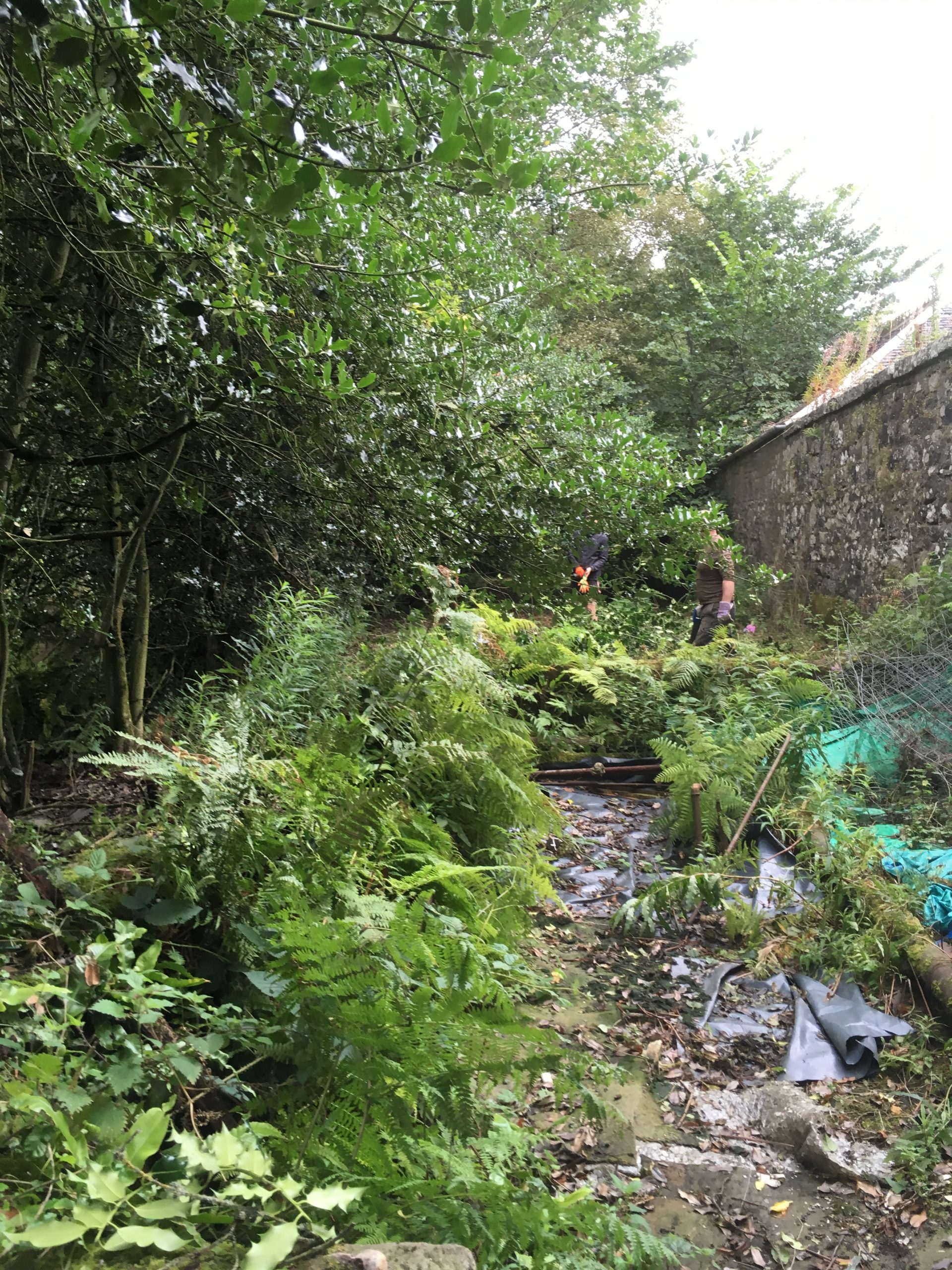
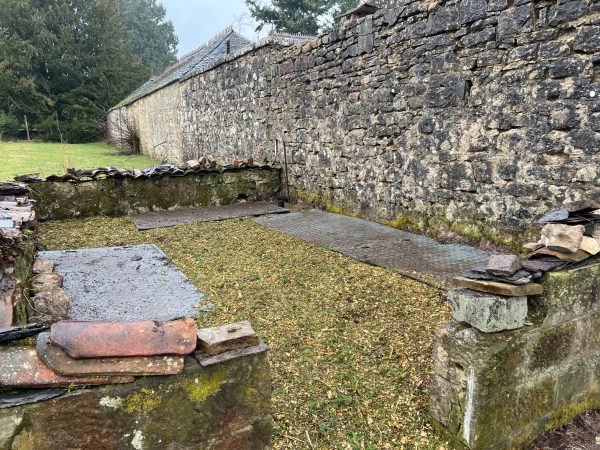
Recently we finished clearing out the old ‘Peach Tree Greenhouse’. It is situated against the warm, south-facing wall of the Enclosed Garden and was successfully used to produce peaches and other tender plants. In the winter, numerous pots of carnations were grown on tiered shelves against the wall, which would act like a radiator giving out some warmth at night, and these highly-perfumed flowers were regularly sent ‘up to the House’ to add a touch of luxury.
Years ago, as the original greenhouse deteriorated, the glass panes collapsed onto the internal soil cramming it full of innumerable shards of glass. Plus, the ruin has provided a sheltered area for a healthy population of willowherb, bramble, bracken and young tree seedlings to flourish so we had a bit of a struggle removing the weeds and stubborn roots whilst avoiding all the buried glass.
Here is a before and after shot of the area, taken a few years apart.
Sweet Breath of Spring
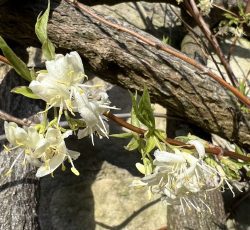
As Spring progresses, our winter-flowering plants are coming to an end. Winter Honeysuckle, (Lonicera fragrantissima) or ‘Sweet breath of Spring’, produces bright, creamy-white flowers from December onwards and although this provides a valuable, early source of nectar, the flowers are relatively small and unobtrusive. In order to successfully attract bees for pollination, the flower produces an intense perfume and it is considered one of the most highly-scented garden plants
Locating Pollen
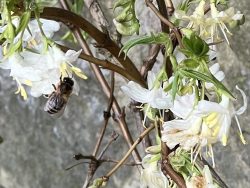
A bee’s sense of direction is often driven by its sense of smell. They can precisely locate pollen from several yards away, determining which type of flowers are nearby, using their odour receptors which are located mainly on their antennae, but also on their legs and feet! These sense cells detect the smell and taste of the flower they are walking on and send the information to the brain. Although attracted by the nectar, the worker honeybees are foraging for the pollen. They hang onto the flower with their hook-like feet while feeding then comb their fur to gather up any stray pollen grains which they store in their customised pollen-baskets. Then they take the pollen back to the colony to feed the developing larvae and for their own nutrition.
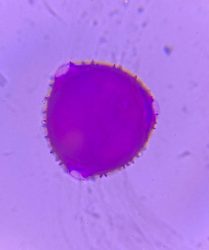
Pollen grains
Pollen grains are rich in protein, and are a honeybees only source of protein, but also contain fats, carbohydrates, vitamins, minerals, organic acids and pigments.
The pollen load from winter honeysuckle is yellow and each pollen grain is about 50 microns across. The three bulging pores (which allow the pollen grain to absorb water) give it a slightly triangular shape.
Plants for Bees
If you want to provide some winter flowering plants for bees you could consider growing Mahonia, crocuses, hellebores, snowdrops and winter flowering heathers. Not only will this help the bees but it will make your garden look much prettier as well!
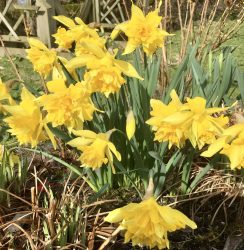
Now that it is almost April, Nature is beginning to shift up a gear or two and there are all sorts of sightings on a near daily basis. The first bumble-bee buzzing across the garden, a Peacock and a Small Tortoiseshell butterfly both trying to land on the same sun-drenched wall and a pair of Mallards noisily considering part of our flooded field as a possible family home. It seemed, from the noises the female was omitting, that she thought the pond really was not big enough for a growing family. Needless to say, they have flown elsewhere. The weeds are beginning to grow and across the woodland the faintest green tint is visible as the leaf buds begin to unfurl. Our snowdrops are fading but already the Easter Daffodils are putting on a glorious show and soon the pear blossom will drip from the trees like dainty snowflakes.
Wishing you all a very Happy Easter !
Photos and text are by Ilona and Margaret
Margaret.
Margaret is the Head gardener and leads the Gardening team.

Ilona.
Ilona is the Head Beekeeper and leads the Apiary team.
More blog posts that you might be interested in reading

Election Time!
Sir Hugh Paterson, 3rd Baronet & The Elections of 1708-15 By Andrew Colquhoun The loyalties of Sir Hugh Paterson, 3rd Baronet and laird of Bannockburn House, were to the exiled House of Stuart. Politics in early eighteenth-century Scotland was rent by sharp...
March Brings Breezes Loud and Shrill, Stirs the Dancing Daffodil
March Brings Breezes Loud and Shrill, Stirs the Dancing Daffodil The first daffodils are always such a welcome sight, a flower of renewal and rebirth. They are impossible to ignore as the neon-yellow-ness of the bobbing flower pierces through any shrubbery, dreary...

Breaking News: Major National Funding Secures Emergency Works at Bannockburn House
The Rescue Begins Major National Funding Secures Emergency Works at Bannockburn House Good news really does come in threes! Bannockburn House Trust is delighted to announce that three major heritage funders have awarded a combined £325,432 to support urgent...
Winter’s End & Spring’s Beginning
Winter’s End and Spring’s Beginning This seems to have been a long, dreary winter. For us here, in central Scotland, our photos record some snow and the there were some sunny, frosty days but it is hard to recall them as there has been such a long stretch of...

New Find in the Bed Linked to Bonnie Prince Charlie at Bannockburn House Deepens the Assassination Attempt Mystery
SPECIAL ANNOUNCEMENT Bannockburn, Stirling - [4 February 2026] Researchers at Bannockburn House have identified new evidence in the suspected assassination attempt on Bonnie Prince Charlie during his stay in January 1746. A lead ball consistent with 18th century shot,...