
Sir Hugh Paterson, 3rd Baronet
&
The Elections of 1708-15
By Andrew Colquhoun
The loyalties of Sir Hugh Paterson, 3rd Baronet and laird of Bannockburn House, were to the exiled House of Stuart. Politics in early eighteenth-century Scotland was rent by sharp divides between Whigs, Tories, and Jacobites. But as Paterson’s parliamentary career shows, eighteenth-century Scottish politics was also often a family affair.
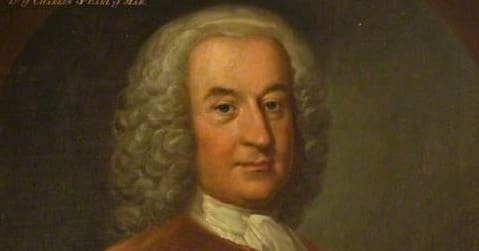
Sir Hugh Paterson, 3rd Brt. Bannockburn.[b]
The first elections in which Paterson was of age to stand were in early summer 1708 (in those days, elections stretched over weeks). These were also the first elections to the parliament of the recently United Kingdom. With only one or two dozen voters in most constituencies, prominent local leaders (usually noble landowners) held a great deal of sway over outcomes. Often, the process was more of a search for consensus than an election as we would recognise one; the local bigwigs would settle on a candidate, and that was that. But amid the divisions and discord of the times, contested elections were growing more common. [1]
Paterson’s stamping ground of Stirlingshire was subject to the influence of three great nobles. The hereditary sheriff of the county was James Livingston, Earl of Linlithgow, who was widely suspected to be of Jacobite sympathies. Behind Linlithgow stood an even more powerful figure, James, 4th Duke of Hamilton, still influential in Jacobite circles despite his lacklustre performance leading the opposition to the Union treaty in 1706-7. For a young man of Paterson’s strong Jacobite principles, Linlithgow was a natural ally.

John, Earl of Mar, Lord Erskine (1703).[c]
The second was John Erskine, 6th Earl of Mar, who was Linlithgow’s second cousin. Mar’s family roots were Episcopalian and Royalist, like Paterson’s, and in 1715 he would lead the Jacobite rising. But in 1708, Mar was still working the system and doing very well at it, chosen as one of the sixteen representatives of the Scottish peers to sit in the British House of Lords. He could not allow his local seat to go to a Jacobite opponent of the Union that he had just worked to secure for the Queen. Mar’s candidate was Henry Cunningham, his distant cousin.
The third magnate was James Graham, Duke of Montrose, who also happened to be Linlithgow’s cousin! Despite Montrose’s descent from his namesake, the famous marquess who had fought for King Charles I, the duke was a solid Whig opponent of the Jacobites.[2] Montrose might have been a natural patron for Cunningham, but there were old local grudges between the Cunninghams and the Grahams. Montrose dithered and dallied with another John Erskine – not Mar, but his second cousin, Sir John of Alva, a baronet – before eventually deciding he could live with Cunningham after all if it meant keeping a Jacobite out.[3]
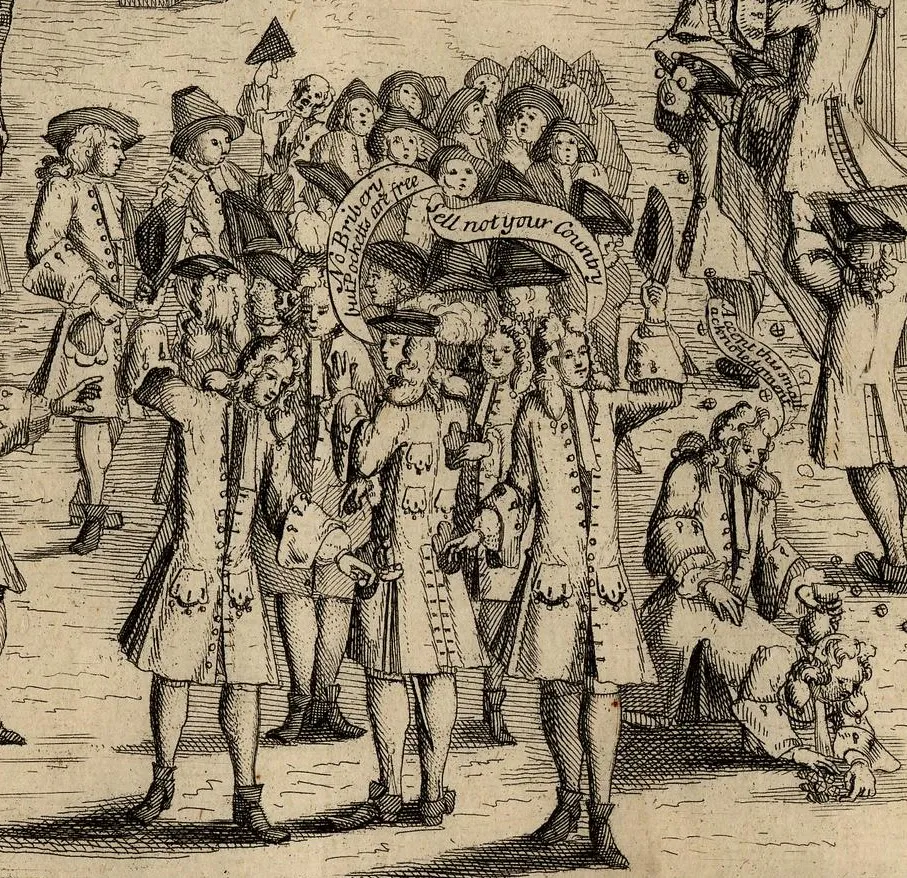
Ready Mony the prevailing candidate, or the Humours of an election (Detail), 1727.[a]
The 1708 elections happened a few weeks after a serious Franco-Jacobite invasion scare, when James VIII/III himself had hovered just off the coast with a French army; the vagaries of the weather had done more than Admiral George Byng’s Royal Navy ships to defeat a landing.[4] Mar led a round-up of usual Jacobite suspects, although Linlithgow and Paterson escaped the dragnet.[5] Still, the united Mar and Montrose interests were strong enough to get Cunningham elected. Linlithgow, as sheriff, returned a disputed result on the thin pretext that Cunningham had only recently become a freeholder of the county, but the new Whig-dominated House of Commons picked Cunningham.
However, the national political landscape and family connections were shifting in Paterson’s favour. The Tory-leaning government of Robert Harley, in which Mar served, was open to Jacobite help to keep the Whigs out. As MP, Cunningham had voted mostly in line with the Whigs since 1708.[6] Accordingly, Mar dumped Cunningham and swung his support behind Paterson, who was returned as MP for the shire. (Cunningham found a bolt-hole in the Stirling Burghs constituency.) In 1712, Paterson married Mar’s sister Jean. The developing Mar connection brought Paterson some reward in the form of a lucrative appointment to the commission of “chamberlainry and trade” in late 1711.
Backed by Linlithgow and Mar, Paterson was returned unopposed in 1711 (when his appointment to an office required him to stand for re-election), and again in 1713.
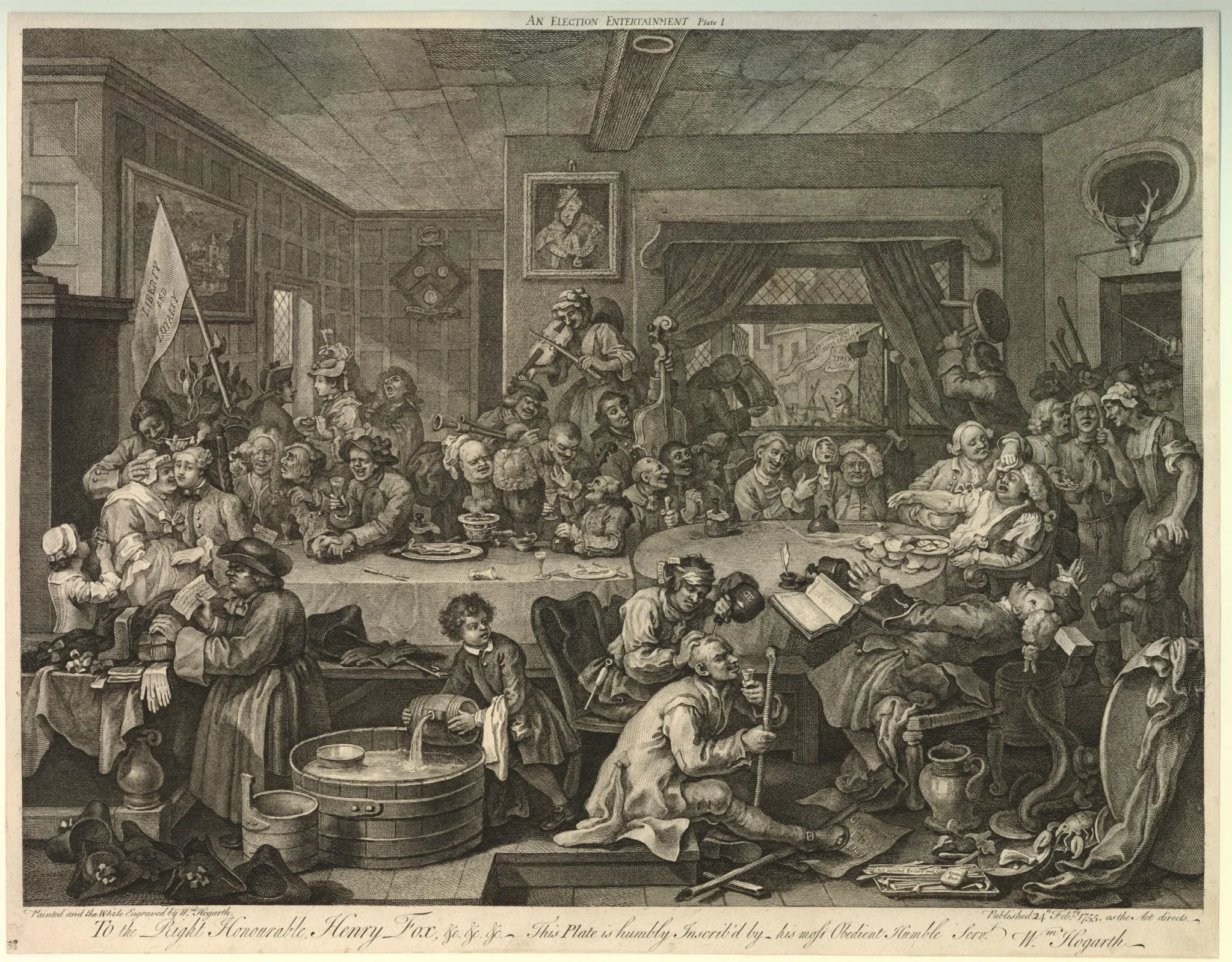
An Election Entertainment, 1755. by William Hogarth. [d]
But the perquisites of office did not induce Paterson to give up his Jacobite loyalties. Around the time of his wedding, a Jacobite lady wrote to the Stuart claimant in exile that Paterson was ‘a man of a good estate and power’ who would ‘contribute to the last farthing he has’ for the cause.[7] Her assessment was borne out by Paterson’s support for the 1715 rising, which led to the forfeiture of his estate and years of exile living on a modest pension from the Stuart court. His brother-in-law James Erskine, Lord Grange (Mar’s brother) bought the estate back for the family in 1720. Paterson was eventually pardoned in 1727. But his Jacobite loyalties were to be stirred again when Prince Charles landed in 1745.
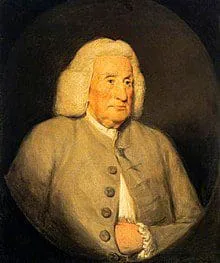
Sir Hugh Paterson, 3rd Brt. Bannockburn.[e]
Want to learn more about Bannockburn House and its 18th century history? Join us on a guided tour! Check out our booking page for details.
About the Author:

Andrew Colquhoun is a volunteer tour guide and member of the Research Team at Bannockburn House. He is currently a postgraduate research student at the University of Glasgow, where his doctoral research, “To be of some use to my native country”: Reappraising John Erskine, 6th Earl of Mar, explores the life and legacy of one of Scotland’s most significant and controversial historical figures.
References:
- Laura Stewart and Janay Nugent, Union and Revolution: Scotland and Beyond, 1625-1745 (Edinburgh: Edinburgh University Press, 2020), p.133
- Ronald M. Sunter, “Graham, James, first duke of Montrose (1682-1742)”, Oxford Dictionary of National Biography (ODNB), (2004), https://doi.org/10.1093/ref:odnb/11197
- Eveline Cruickshanks, Stuart Handley, and D.W. Hayton (eds.), The House of Commons 1690-1715, Vol.III: Members A-F (Cambridge: Cambridge University Press, 2002), p.810
- Daniel Szechi, Britain’s Lost Revolution? Jacobite Scotland and French Grand Strategy, 1701-08 (Manchester: Manchester University Press, 2015), p.37
- Historical Manuscripts Commission, Manuscripts of the House of Lords, Vol VIII (London: HMSO, 1922), p.111
- House of Commons Vol III (2002), p.810
- House of Commons Vol. V (2002), p.112
Photo Attributions:
- a. Anonymous, Ready Mony the prevailing candidate, or the Humours of an election (Detail), 1727, etching on paper, 23.7 x 29.8cm, British Museum, 1868,0808.3520. © The Trustees of the British Museum.
- b. Photograph of Portrait attributed to David Allan (1744-1796) hangs in Alloa Tower (National Trust for Scotland), home of the Erskine Family and on loan from the Earl of Mar and Kellie. Sir Hugh Paterson, 3rd Brt. Bannockburn- Accession number 96.21.12.
- c. Mezzotint with engraving on laid paper by John Smith after Sir Godfrey Kneller of John, Earl of Mar, Lord Erskine (1703). National Gallery of Art, Washington D.C. – Accession number 2001.118.52. Paul Mellon Fund.
- d. William Hogarth, An Election Entertainment,1755, engraving and etching on paper, 43 x 55.1cm, British Museum, S,2.130. © The Trustees of the British Museum.
- e. Portrait by John Thomas Seton (1735–) of Sir Hugh Paterson, 1686-1777. In the collection of National Galleries Scotland – Accession number PG 634.